











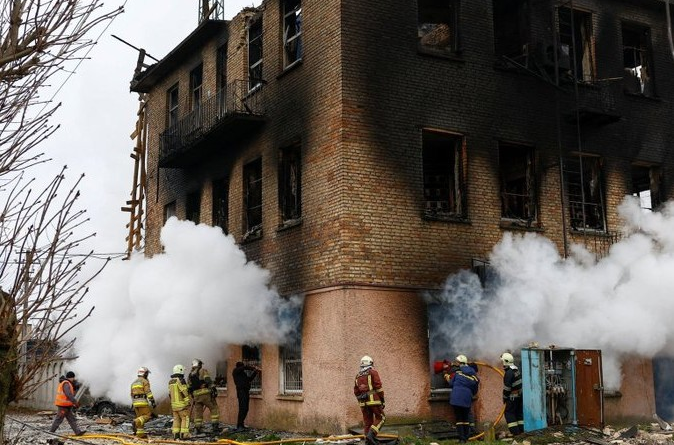
Just a day before Ukraine’s Armed Forces Day, Russia carried out one of its largest aerial assaults of the year on Saturday. According to the Ukrainian Air Force, Russia launched 653 drones and 51 missiles across 29 locations. Ukraine claimed to have intercepted 585 drones and 30 missiles, but the attacks still left eight people injured and caused serious damage to energy stations, railway infrastructure, and communication systems.
The strikes temporarily cut the Zaporizhzhia Nuclear Power Plant off from external power—although no immediate nuclear risk emerged because the reactors remain shut. However, the International Atomic Energy Agency (IAEA) warned that continuous power disruptions pose dangers, as cooling systems still require electricity.
Russia also accused Ukraine of conducting airstrikes inside its territory. Media reports suggested that during its attack, Russia may have accidentally dropped a FAB-1000 high-explosive bomb on its own border city of Belgorod, located about 40 km from Ukraine. The 1,000-kg bomb reportedly failed to fully detonate but created a massive crater. Moscow has not officially confirmed the incident.
Meanwhile, three days of talks between Ukrainian and American officials ended without a breakthrough. Ukrainian President Volodymyr Zelenskyy also held a phone discussion with Donald Trump’s envoy Steve Witkoff and U.S. presidential senior advisor Jared Kushner, though no progress was reported.
Zelenskyy Accuses Russia of Targeting Power Grid
Zelenskyy said Russia deliberately struck electricity stations and grid networks, leading to blackouts across several regions. A drone strike in Fastiv, near Kyiv, completely destroyed a railway station.
International Reactions Intensify
French President Emmanuel Macron strongly condemned Russia’s latest attacks, saying:
“Russia does not want peace. Its actions show constant provocation. The world must increase pressure to push Moscow toward a peaceful resolution.”
UK Prime Minister Keir Starmer reaffirmed support for Ukraine, saying that Ukraine alone will decide its future and that international peacekeeping frameworks would ensure its long-term security.
Russian President Vladimir Putin, meanwhile, issued fresh warnings to European nations, claiming that if Europe chooses to escalate militarily, Russia is “fully prepared to respond.” He added ominously that such a conflict would “end so quickly that nobody would be left to negotiate.”