
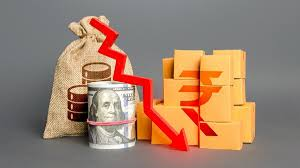
The Indian Rupee has once again slipped to a historic low against the US Dollar, raising concerns across financial markets and among common citizens. The continuous fall in the INR vs USD exchange rate is not just a currency issue—it directly impacts inflation, fuel prices, imports, foreign investments, travel costs, and the overall Indian economy.
With global tensions rising due to the ongoing US-Iran conflict, increasing crude oil prices, and heavy pressure on emerging market currencies, the Indian Rupee is facing one of its toughest phases in recent years. Financial experts believe that the weakening Rupee could trigger higher inflation and increase the cost of living for millions of Indians.
Why Is the Indian Rupee Falling Against the Dollar?
There are several major reasons behind the sharp decline in the Indian Rupee. The biggest factor is the strengthening of the US Dollar in global markets. Whenever the American economy becomes stronger or global uncertainty increases, investors prefer the Dollar as a “safe-haven currency.” This increases demand for the Dollar and weakens currencies like the Indian Rupee.
Another major reason is the rise in crude oil prices. India imports nearly 85% of its crude oil requirements from other countries. Since oil purchases are made in US Dollars, a stronger Dollar means India has to spend more money on imports. As oil becomes expensive globally, the demand for Dollars rises sharply, putting additional pressure on the Rupee.
The ongoing geopolitical tensions between the United States and Iran have further intensified the situation. Global investors are becoming cautious and are moving their investments toward safer assets like US Treasury bonds and the Dollar. This has resulted in foreign investors pulling money out of Indian stock markets, weakening the Rupee even more.
Impact of Rupee Falling on the Indian Economy
A weak Rupee affects almost every sector of the Indian economy. One of the biggest impacts is on inflation. Since India imports a large amount of crude oil, electronic goods, machinery, chemicals, and other essential products, a weaker Rupee makes these imports more expensive.
As import costs rise, companies pass the burden on to consumers, leading to higher prices of goods and services. This directly affects household budgets and increases the overall cost of living.
Rising Petrol and Diesel Prices
One of the most visible effects of a weak Rupee is the increase in petrol and diesel prices. Since crude oil imports become costlier, oil marketing companies may eventually increase fuel prices. Higher fuel prices also impact transportation costs, food delivery, logistics, and public transport.
Expensive Foreign Education and Travel
The weakening Indian Rupee is also bad news for students planning to study abroad. Tuition fees, accommodation costs, and living expenses in countries like the US, UK, Canada, and Australia become significantly more expensive when the Dollar strengthens.
Similarly, international travel becomes costlier for Indian tourists. Flight tickets, hotel bookings, shopping, and overseas expenses all increase due to the unfavorable exchange rate.
Pressure on Businesses and Imports
Indian companies that depend heavily on imports are also facing major challenges. Sectors like electronics, smartphones, automobiles, aviation, pharmaceuticals, and manufacturing may witness increased operational costs.
Companies with loans in foreign currencies may also struggle because repayment becomes more expensive when the Rupee weakens.
Is There Any Benefit of a Weak Rupee?
While a falling Rupee creates several economic challenges, it can also offer some advantages in certain sectors. Indian exporters may benefit because their products become cheaper for foreign buyers.
Industries such as IT services, software exports, textiles, pharmaceuticals, and business outsourcing often gain when the Rupee weakens. Companies earning revenue in Dollars can generate higher profits after converting their earnings into Indian currency.
This is one reason why many Indian IT companies sometimes perform better during periods of Rupee depreciation.
What Is RBI Doing to Control the Situation?
The Reserve Bank of India (RBI) continuously monitors the foreign exchange market to prevent excessive volatility. The central bank can intervene by selling Dollars from its foreign exchange reserves to stabilize the Rupee.
Apart from intervention, RBI may also adjust interest rates and liquidity measures to support the currency and control inflation.
However, experts believe that global factors such as crude oil prices, US Federal Reserve policies, and geopolitical tensions will continue to influence the Rupee in the short term.
How Does the US-Iran Conflict Affect the Rupee?
The ongoing tensions between the United States and Iran are creating uncertainty in global energy markets. Any disruption in oil supply from the Middle East can push crude oil prices even higher.
Since India relies heavily on imported oil, rising geopolitical tensions directly impact India’s trade deficit and currency value. Investors usually avoid risky markets during global conflicts, which leads to capital outflows from emerging economies like India.
As a result, the Indian Rupee faces additional downward pressure.
What Experts Are Saying About the Future of INR
Market analysts believe the Indian Rupee may remain volatile in the coming weeks. Much will depend on global crude oil prices, foreign investment flows, and the decisions of the US Federal Reserve regarding interest rates.
If global tensions ease and oil prices stabilize, the Rupee could recover gradually. However, if geopolitical uncertainty continues and crude oil prices rise further, the Rupee may remain under pressure for a longer period.