
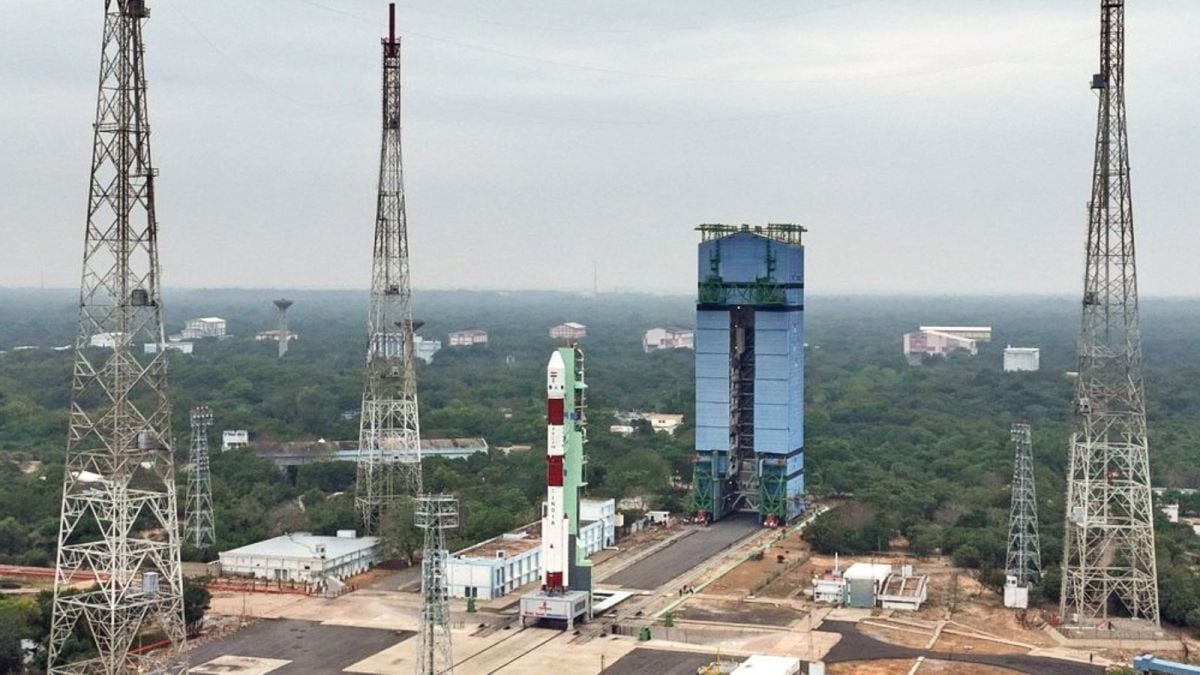
Sriharikota: India’s space programme suffered a major setback on January 12, 2026, as the PSLV-C62 mission failed due to a technical malfunction in the rocket’s third stage, marking the second PSLV failure in less than a year.
The mission, launched from Satish Dhawan Space Centre, Sriharikota at 10:18 AM, was carrying 16 satellites, including the EOS-N1 (Anvesha) Earth observation satellite. These satellites were meant to be placed into a 512 km Sun-Synchronous Orbit (SSO).
What Went Wrong?
According to ISRO Chairman Dr. V. Narayanan, the launch was smooth during the initial phases, but about 8 minutes into the flight, a serious anomaly occurred in the third stage (PS3) of the rocket.
“There was a sudden drop in chamber pressure in the third stage, which resulted in insufficient thrust. Because of this, the vehicle deviated significantly from its intended trajectory, and the satellites could not be injected into orbit,” Narayanan said.
Due to this failure:
- The fourth stage (PS4) could not perform its planned ignition
- The satellites were never deployed
- The re-entry manoeuvre and separation of the Spanish KID capsule (Kestral Initial Technology Demonstrator) could not take place
The full mission was planned to last 1 hour 48 minutes, but it effectively ended within the first 8 minutes.
A Repeat of 2025 Failure
This is not the first such incident. In May 2025, ISRO’s PSLV-C61 mission had also failed due to a third-stage technical issue while attempting to place the EOS-09 satellite into a 524 km orbit.
Two similar failures in the same stage of the rocket have now raised serious concerns over system reliability and quality control.
ISRO Orders Full Technical Probe
ISRO has constituted a Failure Analysis Committee which will:
- Examine telemetry data
- Inspect the flex nozzle system
- Recreate similar load conditions
- Identify the root cause of the pressure drop
The space agency has not officially declared the mission a complete failure, but historically, third-stage malfunction means the mission is considered unsuccessful.
Why This Mission Was Important
The mission was supposed to:
- Deploy EOS-N1 (Anvesha) for Earth observation
- Release 15 additional satellites
- Test controlled re-entry of PS4 stage
- Deploy a technology demonstration capsule from Spain
None of these objectives could be completed.
Bigger Concern for ISRO
With two PSLV failures in consecutive missions, this setback comes at a time when:
- India is expanding its commercial launch market
- Gaganyaan and other major missions are in preparation
- ISRO’s global reliability image is at stake
Experts believe system-level audits and design reviews will now be unavoidable before the next PSLV launch.