
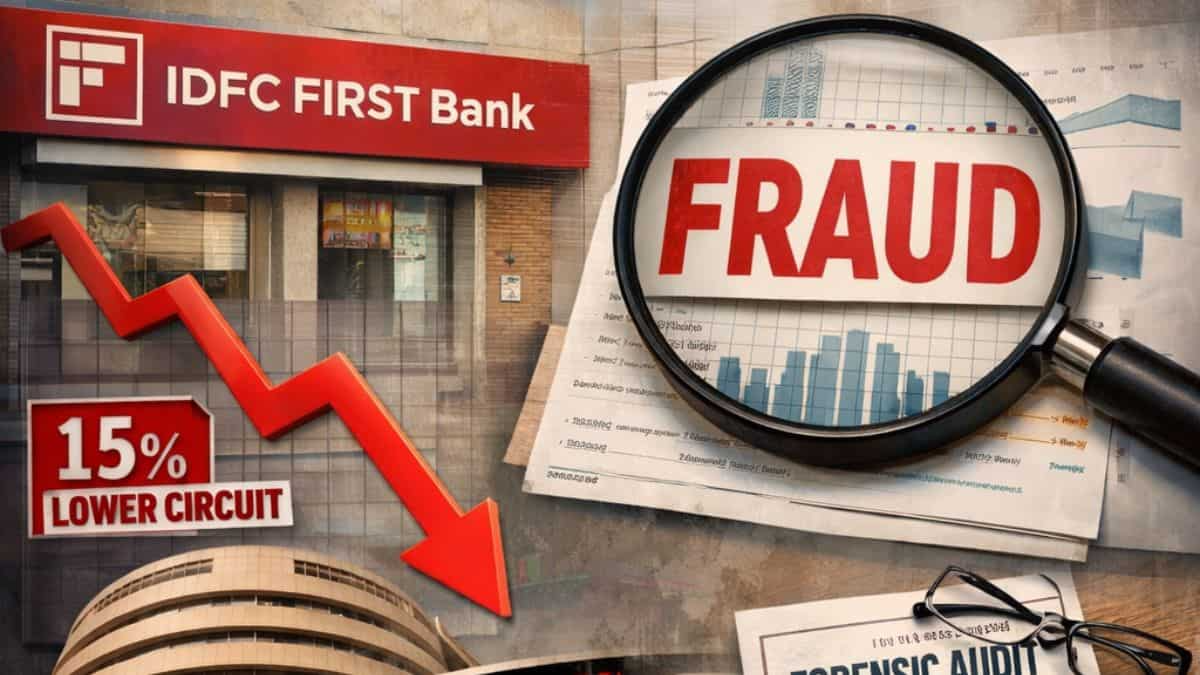
Shares of IDFC First Bank plunged sharply on Monday following the lender’s disclosure of a suspected fraud worth approximately ₹590 crore at one of its branches in Chandigarh. The stock’s sharp fall has rattled investors and triggered broader market attention.
How the Stock Reacted
In early trading, the bank’s stock dropped as much as 20% — its steepest fall in several years — even as broader indices like the Sensex and Nifty were trading higher. The share hit its lower circuit limit as selling pressure intensified.
At one point, price levels dipped to around ₹66-₹67 on the BSE/NSE compared with the previous closing levels in the low ₹80s, wiping out significant investor wealth in a single session.
Fraud Details and Market Impact
The fraud came to light after discrepancies were found in transactions linked to accounts held by entities of the Haryana state government at the Chandigarh branch. Authorities noticed mismatches between recorded balances and account documentation when a government department sought to close its account and transfer funds.
Preliminary internal reviews suggest the irregularities are confined to specific government-linked accounts and do not reflect a systemic failure across the bank’s operations. However, four employees connected to the branch have been suspended pending further investigation, and the bank has filed police complaints while initiating disciplinary and legal action.
To assess the situation and establish accountability, the bank has appointed KPMG for an independent forensic audit to ascertain how the fraudulent transactions occurred and the extent of the financial impact.
Government & Regulatory Response
Following the fraud disclosure, the Haryana government de-empanelled IDFC First Bank (alongside another private lender, AU Small Finance Bank) from handling government business, ordering departments to cease routing funds or transacting via the affected banks until further notice.
Despite the volatility, the Reserve Bank of India (RBI) has indicated there is no systemic risk to the broader banking system from this isolated incident, seeking to reassure both markets and depositors.
Analysts’ View & Next Steps
Brokerages and analysts have responded with mixed assessments. Some have played down the long-term fundamental damage, describing the fraud as an operational lapse rather than an indicator of deeper governance issues, while others have flagged potential earnings pressure depending on the scale of recoveries and provisioning.
Nomura, for example, has noted that although the issue appears localised, it raises concerns around governance and internal controls at the branch level, and it could weigh on sentiment until the full audit and recovery picture becomes clearer.
Market watchers will be closely following further developments, particularly independent audit findings and official statements regarding any material loss once claims and recovery avenues have been explored.