
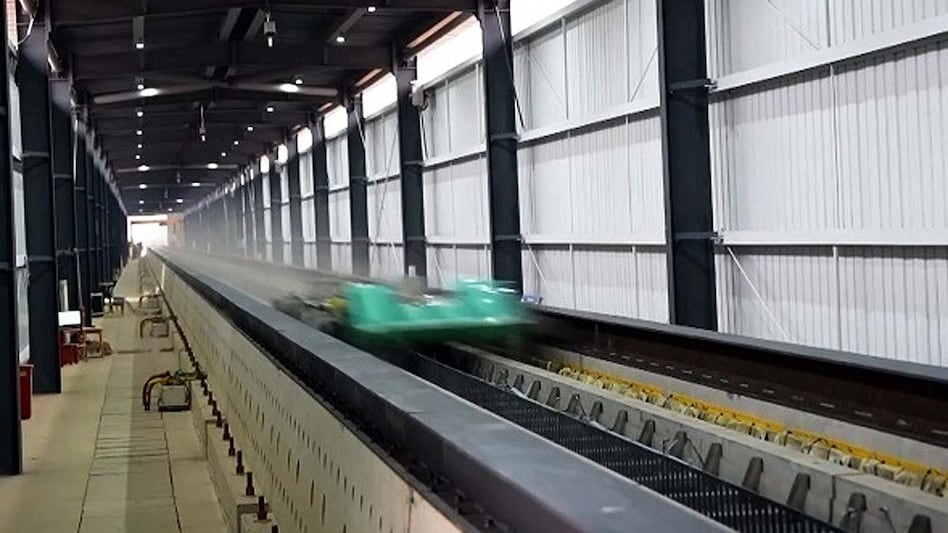
China has once again stunned the world in high-speed transportation innovation. In a groundbreaking test, Chinese scientists accelerated a maglev train to an astonishing 700 km/h in only two seconds, establishing a new world record in superconducting magnetic levitation technology.
Record-Breaking High-Speed Maglev Achievement
The test was conducted by researchers from the National University of Defence Technology (NUDT) on a specially built 400-meter magnetic levitation (maglev) track. The experimental vehicle, weighing approximately 1.1 tonnes, reached 700 km/h (435 mph) from standstill in just two seconds and was brought safely to a stop.
This incredible feat marks the fastest acceleration and peak speed ever achieved for a superconducting maglev system, breaking all previous records in ultra-high-speed rail research.
How Maglev Works
Unlike conventional trains, maglev trains levitate above the tracks using powerful superconducting magnets. This eliminates friction between wheels and rails, allowing for dramatically faster speeds with smoother motion and less wear-and-tear.
Experts say this technology is a major leap forward in electromagnetic propulsion systems, featuring:
Ultra-high-speed magnetic levitation
Advanced electric suspension and guidance
High-power energy storage systems
High-field superconducting magnets
These innovations are central to achieving high speed while maintaining safety and control.
Beyond Rail Transport
The implications of this breakthrough extend far beyond rail travel. Scientists believe the same maglev and electromagnetic principles can be applied to future vacuum-tube transportation systems (hyperloop), aerospace launch systems, and next-generation transit technologies.
China’s decade-long push in ultra-high-speed transport research has now placed it among the world’s leaders in cutting-edge travel innovation, showcasing a future where distances could be covered in mere minutes.